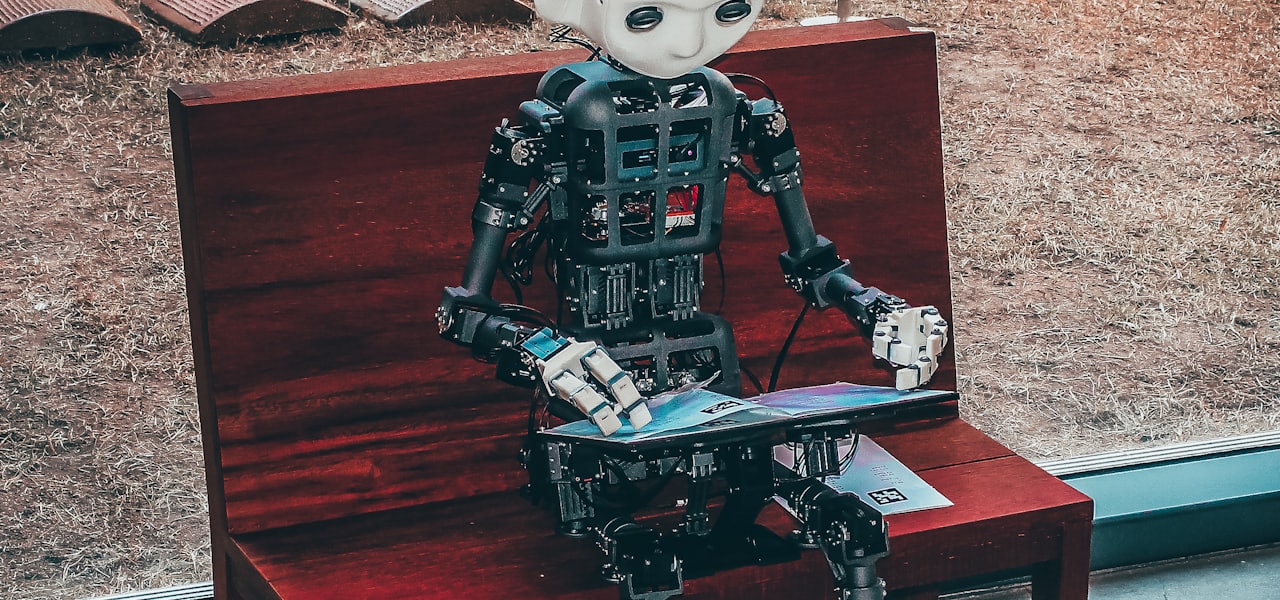
Necrobotics is the practice of using biotic materials (or dead organisms) as robotic components. Necrobotics can serve as an alternative to mechanical components that are difficult to manufacture by using biological components designed by natural selection in order to exploit the highly developed selective design implemented in biological lifeforms via the process of evolution. In July 2022, researchers in the Preston Innovation Lab at Rice University in Houston, Texas published a paper in Advanced Science introducing the concept and demonstrating its capability by repurposing dead spiders as robotic grippers and applying pressurized air to activate their gripping arms. In April 2025 researchers at Shinshu University created a “bio-hybrid drone” using silk-worm moth antennae to detect the source of a smell. In November 2025 researchers at McGill University demonstrated the use of a mosquito proboscis as a fine nozzle in experimental 3D printing. Necrobotics utilizes the spider's organic hydraulic system and their compact legs to create an efficient and simple gripper system. The necrobotic spider gripper is capable of lifting small and light objects, thereby serving as an alternative to complex and costly small mechanical grippers. == Background == The main appeal of the spider's body in necrobotics is its compact leg mechanism and use of hydraulic pressure. The spider's anatomy utilizes a simple hydraulic (fluid) pressure system. Spider legs have flexor muscles that naturally constrict their legs when relaxed. A force is required to straighten and extend their legs, which spiders accomplish by pumping hemolymph fluid (blood) through their joints as a means of hydraulic pressure. It takes no external power to curl their legs due to their flexor muscles' natural curled state. In July 2022, researchers in the Preston Innovation Lab at Rice University published a paper detailing their experiments with the gripper. Although dead spiders no longer produce hemolymph, Te Faye Yap (lead author and mechanical engineering graduate) found that pumping air through a needle into the spider's cephalothorax (main body) accomplishes the same results as hemolymph. The original hydraulic (fluid) system is essentially converted into a pneumatic (air) system. == Fabrication == Obtain a spider Euthanize the spider using a cold temperature of around -4°C for 5-7 days Insert a 25 gauge hypodermic needle into the spider's cephalothorax (main body) Apply glue around the needle to form a seal and allow it to dry Connect a syringe or pump to the needle Extend the spider's legs by pumping air in == Testing and Data == === Internal Force Versus Gripping Force === The typical pressure in a resting spider's legs ranges from 4 kPa to 6.1 kPa. Researchers extended the legs by increasing the spider's internal pressure to 5.5 kPa. Pumping air into the body increases the internal pressure, causing the legs to expand. Pumping air out of the body decreases internal pressure, causing the legs to contract due to their flexor leg muscles. When the internal pressure decreases to 0 kPa, the gripper would be fully closed, allowing for the gripper to grasp objects. This action demonstrates that as internal pressure decreases, the gripping force increases. Inversely, when internal pressure increases, the gripping force decreases. By gripping individual weighted acetate beads, it is found that the necrobotic gripper achieves a maximum gripping force of 0.35 milinewtons. === Spider Weight Versus Gripping Force === To estimate the gripping forces of smaller and larger spiders, researchers created a plot to predict the gripping force relative to the size of the spider. The wolf spider's body weight is relatively equal to the gripping force of its legs. The mass of the gripper is 33.5 mg and can lift 1.3 times its body weight (43.6 mg or 0.35 mN). However, with larger spiders, the gripping force relative to body weight decreases. For example, a 200-gram goliath birdeater is predicted to lift 10% of its weight (20 grams or 196 mN). Though there is an inverse relationship between spider mass and gripping force, larger spiders exert greater gripping forces than smaller spiders. === Gripper Lifespan === The necrobotic gripper's functionality is entirely reliant on the structural integrity of the spider. If the spider were to break down easily and frequently, the gripper would not be practical. Using cyclic testing, a series of repeated actions, it is found that the necrobotic gripper can actuate 700 to 1000 times. After 1000 cycles, cracks begin forming on the membrane of the leg joints due to dehydration. Weakened and decomposing joints lead to frequent breakage and replacement, thereby serving as an obstacle in applying necrobotics to real-world scenarios. One theorized fix to this issue is applying beeswax or a lubricant to the joints. Researchers found that over 10 days, the mass of an uncoated spider decreased 17 times more than the mass of a spider coated with beeswax. Lubricating joints combats dehydration and slows the loss of organic material. == Constraints == With the usage of organic material, there is a higher chance of the component decomposing and breaking down as opposed to traditional mechanical systems. There may be additional work and management required to replace these grippers if they fail. Additionally, organic inconsistencies with the spiders will yield inaccurate results. Not all wolf spiders develop the same, so gripping force and leg contraction can vary between grippers. There are moral implications behind euthanizing spiders for robotics. The ethical boundaries that necrobotics push in the pursuit of biohybrid systems raise concerns, as opponents say it may lead to the hybridization of mammals and is intrusive to nature. Proponents respond that repurposing dead animals has been human practice for millennia and that necrobotics should be pursued to advance science.
COVID-19 apps
COVID-19 apps include mobile-software applications for digital contact-tracing—i.e. the process of identifying persons ("contacts") who may have been in contact with an infected individual—deployed during the COVID-19 pandemic. Numerous tracing applications have been developed or proposed, with official government support in some territories and jurisdictions. Several frameworks for building contact-tracing apps have been developed. Privacy concerns have been raised, especially about systems that are based on tracking the geographical location of app users. Less overtly intrusive alternatives include the co-option of Bluetooth signals to log a user's proximity to other cellphones. (Bluetooth technology has form in tracking cell-phones' locations.)) On 10 April 2020, Google and Apple jointly announced that they would integrate functionality to support such Bluetooth-based apps directly into their Android and iOS operating systems. India's COVID-19 tracking app Aarogya Setu became the world's fastest growing application—beating Pokémon Go—with 50 million users in the first 13 days of its release. == Rationale == Contact tracing is an important tool in infectious disease control, but as the number of cases rises time constraints make it more challenging to effectively control transmission. Digital contact tracing, especially if widely deployed, may be more effective than traditional methods of contact tracing. In a March 2020 model by the University of Oxford Big Data Institute's Christophe Fraser's team, a coronavirus outbreak in a city of one million people is halted if 80% of all smartphone users take part in a tracking system; in the model, the elderly are still expected to self-isolate en masse, but individuals who are neither symptomatic nor elderly are exempt from isolation unless they receive an alert that they are at risk of carrying the disease. Some proponents advocate for legislation exempting certain COVID-19 apps from general privacy restrictions. == Issues == === Uptake === Ross Anderson, professor of security engineering at Cambridge University, listed a number of potential practical problems with app-based systems, including false positives and the potential lack of effectiveness if takeup of the app is limited to only a small fraction of the population. In Singapore, only one person in three had downloaded the TraceTogether app by the end of June 2020, despite legal requirements for most workers; the app was also underused, as it required users to keep it open at all times on iOS. A team at the University of Oxford simulated the effect of a contact tracing app on a city of 1 million. They estimated that if the app was used in conjunction with the shielding of over-70s, then 56% of the population would have to be using the app for it to suppress the virus. This would be equivalent to 80% of smartphone users in the United Kingdom. They found that the app could still slow the spread of the virus if fewer people downloaded it, with one infection being prevented for every one or two users. In August 2020, the American Civil Liberties Union (ACLU) argued that there were disparities in smartphone use between demographics and minority groups, and that "even the most comprehensive, all-seeing contact tracing system is of little use without social and medical systems in place to help those who may have the virus — including access to medical care, testing, and support for those who are quarantined." === App store restrictions === Addressing concerns about the spread of misleading or harmful apps, Apple, Google and Amazon set limits on which types of organizations could add coronavirus-related apps to its App Store, limiting them to only "official" or otherwise reputable organizations. === Ethical principles of mass surveillance using COVID-19 contact tracing apps === The advent of COVID-19 contact tracing apps has led to concerns around privacy, the rights of app users, and governmental authority. The European Convention on Human Rights, the International Covenant on Civil and Political Rights (ICCPR) and the United Nations and the Siracusa Principles have outlined 4 principles to consider when looking at the ethical principles of mass surveillance with COVID-19 contact tracing apps. These are necessity, proportionality, scientific validity, and time boundedness. Necessity is defined as the idea that governments should only interfere with a person's rights when deemed essential for public health interests. The potential risks associated with infringements of personal privacy must be outweighed by the possibility of reducing significant harm to others. Potential benefits of contact-tracing apps that may be considered include allowing for blanket population-level quarantine measures to be lifted sooner and the minimization of people under quarantine. Hence, some contend that contact-tracing apps are justified as they may be less intrusive than blanket quarantine measures. Furthermore, the delay of an effective contact-tracing app with significant health and economic benefits may be considered unethical. Proportionality refers to the concept that a contact tracing app's potential negative impact on a person's rights should be justifiable by the severity of the health risks that are being addressed. Apps must use the most privacy-preserving options available to achieve their goals, and the selected option should not only be a logical option for achieving the goal but also an effective one. Scientific validity evaluates whether an app is effective, timely and accurate. Traditional manual contact-tracing procedures are not efficient enough for the COVID-19 pandemic, and do not consider asymptomatic transmission. Contact-tracing apps, on the other hand, can be effective COVID-19 contact-tracing tools that reduce R value to less than 1, leading to sustained epidemic suppression. However, for apps to be effective, there needs to be a minimum 56-60% uptake in the population. Apps should be continually modified to reflect current knowledge on the diseases being monitored. Some argue that contact-tracing apps should be considered societal experimental trials where results and adverse effects are evaluated according to the stringent guidelines of social experiments. Analyses should be conducted by independent research bodies and published for wide dissemination. Despite the current urgency of our pandemic situation, we should still adhere to the standard rigors of scientific evaluation. Time boundedness describe the need for establishing legal and technical sunset clauses so that they are only allowed to operate as long as necessary to address the pandemic situation. Apps should be withdrawn as soon as possible after the end of the pandemic. If the end of the pandemic cannot be predicted, the use of apps should be regularly reviewed and decisions about continued use should be made at each review. Collected data should only be retained by public health authorities for research purposes with clear stipulations on how long the data will be held for and who will be responsible for security, oversight, and ownership. === Privacy, discrimination and marginalisation concerns === The American Civil Liberties Union (ACLU) has published a set of principles for technology-assisted contact tracing and Amnesty International and over 100 other organizations issued a statement calling for limits on this kind of surveillance. The organisations declared eight conditions on governmental projects: surveillance would have to be "lawful, necessary and proportionate"; extensions of monitoring and surveillance would have to have sunset clauses; the use of data would have to be limited to COVID-19 purposes; data security and anonymity would have to be protected and shown to be protected based on evidence; digital surveillance would have to address the risk of exacerbating discrimination and marginalisation; any sharing of data with third parties would have to be defined in law; there would have to be safeguards against abuse and the rights of citizens to respond to abuses; "meaningful participation" by all "relevant stakeholders" would be required, including that of public health experts and marginalised groups. The German Chaos Computer Club (CCC) and Reporters Without Borders also issued checklists. The Exposure Notification service intends to address the problem of persistent surveillance by removing the tracing mechanism from their device operating systems once it is no longer needed. On 20 April 2020, it was reported that over 300 academics had signed a statement favouring decentralised proximity tracing applications over centralised models, given the difficulty in precluding centralised options being used "to enable unwarranted discrimination and surveillance." In a centralised model, a central database records the ID codes of meetings between users. In a decentralised model, this information is recorded on individual phones, with the role of the central
Greg Brockman
Gregory Brockman (born November 29, 1987) is an American entrepreneur and software engineer. He is co-founder and president of OpenAI. He began his career at Stripe in 2010, upon leaving MIT, and became CTO in 2013. He left Stripe in 2015 to co-found OpenAI, where he also served as CTO. == Early life == Brockman was born in Thompson, North Dakota, and attended Red River High School, where he excelled in mathematics, chemistry, and computer science. He won a silver medal in the 2006 International Chemistry Olympiad and became the first finalist from North Dakota to participate in the Intel science talent search since 1973. In 2003, 2005, and 2007, he attended Canada/USA Mathcamp, a summer program for mathematically talented high-school students. In 2008, Brockman enrolled at Harvard University but left a year later, briefly enrolling at the Massachusetts Institute of Technology. == Career == In 2010, he dropped out of MIT to join Stripe, a company founded by Patrick Collison, his MIT classmate, and John Collison. In 2013, he became Stripe's first CTO, while the company grew from 5 to 205 employees. Brockman left Stripe in May 2015. === OpenAI === Brockman met with Sam Altman and Elon Musk, and led the recruiting of the OpenAI founding team. Many of its members, including Ilya Sutskever, were top AI research talent that left high paying jobs for the opportunity at OpenAI. He co-founded OpenAI in December 2015 alongside Altman, Sutskever and others. The company initially operated from Brockman's living room. He led various projects at OpenAI, including OpenAI Gym and OpenAI Five, a Dota 2 bot. On February 14, 2019, OpenAI announced that they had developed a new large language model called GPT-2, but kept it private due to their concern for its potential misuse. They released the model to a limited group of beta testers in May 2019. On March 14, 2023, in a live video demo, Brockman unveiled GPT-4, the fourth iteration in the GPT series. On November 17, 2023, alongside the firing of Sam Altman, Brockman was told he had been removed from the board. Sutskever supplied the board with a document of alleged bullying by Brockman. Mira Murati said Brockman's relationship with Altman made it impossible for her to do her job, and Altman had already "fielded many requests from OpenAI employees to rein in Brockman". Brockman was to report to Murati, but on November 17, he announced that he had quit the company. On November 20, 2023, Microsoft CEO Satya Nadella announced that Brockman and Altman would join Microsoft to lead a new advanced AI research team. The following day, after a deal was reached to reinstate Altman as CEO, Brockman returned to OpenAI. Brockman took a sabbatical from August to November 2024. === Elon Musk lawsuit === Jury selection for OpenAI cofounder Elon Musk's lawsuit against OpenAI and its current executives, including Brockman, began on April 27, 2026. On April 28, 2026, trial testimony was by now underway, with Elon Musk beginning his testimony against Altman and OpenAI. On April 30, 2026 Musk would enter his third day of testimony. == Personal life == In November 2019 after a year of dating, Brockman married Anna at OpenAI's offices on a workday. Ilya Sutskever officiated. == Political activities == Brockman and his wife were the biggest donors to Donald Trump's Super PAC, MAGA Inc., in 2025 with each of them donating US$12.5 million. Brockman and his wife also donated $50 million to Leading the Future, a super PAC dedicated to AI deregulation that he helped found with Andreessen Horowitz co-founders Marc Andreessen and Ben Horowitz. OpenAI publicly expressed openness to increased regulatory oversight and has a policy against donating to such Super PACs.
Daniel Wolfe
Daniel Wolfe (born 1960) is an American activist, advocate, and writer whose work advances health programs and policy that balance scientific research and community expertise. His career has focused on support for community health movements, particularly among groups often regarded as criminal or socially suspect, including gay men and people who use illicit drugs. == Early life == Wolfe was raised between Arizona—including time on Rancho Linda Vista, a commune outside of Tucson—and East Hampton, NY. He received his undergraduate degree in Near Eastern Studies from Princeton University, and following time studying Arabic in Egypt, worked as the junior ghostwriter on the autobiographies of First Lady of Egypt Jehan Sadat and Pakistani Prime Minister Benazir Bhutto. Upon return to New York, he was an assistant at the Council on Foreign Relations to Richard W. Murphy, former US Assistant Secretary of State for Near Eastern and South Asian Affairs. Disagreement with US killing of Iraqi civilians during the 1990 Gulf War—and the rising toll of HIV in NY—moved Wolfe to leave Middle East studies and work full-time on AIDS in 1990. == Education == Wolfe was Community Scholar at the Columbia University Mailman School of Public Healthwhere he received his Masters in Public Health in 2004. He holds a Masters of Philosophy (in history) from Columbia University, and a BA in Near Eastern Studies from Princeton University. He was the recipient of a Charles H. Revson Foundation fellowship for urban leaders who have made a substantial contribution to New York City, and a fellow at the Center for Arabic Studies Abroad in Cairo, Egypt. == AIDS and gay activism == Wolfe was part of the media committee for ACT UP’s 1998 action to seize control of the FDA, and helped organize ACT UP NY’s challenge to Governor Cuomo to do better on the AIDS response and other actions.Wolfe also joined ACT UP colleagues Gregg Bordowitz, David Barr, Richard Elovich, Jean Carlomusto and others to work at Gay Men’s Health Crisis (GMHC), the nation’s first AIDS organization, where he served as director of communications and spokesperson on issues including opposition to NY State cuts to the AIDS budget, the disclosure that Olympic Champion Greg Louganis had HIV, reports of the FBI spying on AIDS activists, and GMHC’s move to offer HIV testing and targeted support to those who were HIV-negative. Wolfe also continued cultural work, making art, performance and video as a member of the gay and lesbian collective GANG with artists and ACT UP members including Zoe Leonard, Suzanne Wright, Loring McAlpin, Wellington Love, Adam Rolston and others, and writing a biography of Lawrence of Arabia for a series for young adults on famous gay men and lesbians in history edited by Martin Duberman. Controversy followed, with North Carolina Senator Jesse Helms waving a GANG piece in an issue of the Movement Research Performance Journal on the floor of Congress to show the "rottenness" of publicly funded art, and a number of schools banning the biography series for young adults from their libraries. Wolfe and others challenged the move as continuing the longstanding and homophobic demand that notable gay men and lesbians stay silent about essential details of their private lives even while being celebrated for their professional achievements. == Gay health == The approval of antiretroviral therapy for HIV in 1996 opened up new space for discussions of gay health beyond HIV, and new directions for Wolfe. Working from hundreds of interviews, surveys, workshops, and with a team of writers, Wolfe was the author of Men Like Us, the Our Bodies, Ourselves-inspired GMHC Complete Guide to Gay Men’s Sexual, Physical, and Emotional Well-being, covering issues from spirituality to sexual health to aging. The move to frame gay health beyond condoms and pills—and to offer a guide to health that “did not need to be translated from the original heterosexual”—was part of a larger gay health movement encompassing wellness and pleasure, and focused less on health disparity than on individual and community resilience. Wolfe was a keynote speaker and workshop leader, along with Eric Rofes, Chris Bartlett, and other organizers, at the first National Gay Men’s Health Summit held in Boulder, Colorado in 2002. Awarded a Charles H. Revson Fellowship for urban leaders in the City of New York, Wolfe became a community scholar at Columbia University’s Center of History and Ethics of Public Health, where he received his MPH in 2003, and was a contributor to Searching Eyes: Privacy, the State, and Disease Surveillance in America. == International harm reduction == Wolfe was Director of International Harm Reduction Development at the Open Society Foundations (2005-2021) where he led grantmaking and advocacy to protect the health and rights of people who use drugs in Eastern Europe, Asia, Africa and the Americas. Wolfe challenged approaches that conditioned support on abstinence or that sought to treat people who use illegal drugs like drugs themselves, as something to be controlled or contained. As with the gay health movement, he advocated a focus on community resilience and strengths, and on supporting individuals and communities to negotiate the balance between risk and pleasure of activities integral to life. Noting what he called the “antisocial behavior of health systems,” Wolfe’s analysis elevated issues such as forced labor and harsh punishment delivered in the name of addiction treatment and rehabilitation, the role of criminalization, imprisonment and stigma in interrupting or impeding HIV treatment, and the bias toward coercive approaches in studying and delivering addiction treatments. He also pointed to defects in national and international drug control policies and human rights violations as a root cause of HIV, hepatitis, and other health challenges faced by people who used drugs. Concrete advocacy supported by Open Society’s International Harm Reduction Development program under his direction included rebuffing US government efforts to force the UN to remove all references to harm reduction in its materials, addition of the addiction treatment medicines methadone and buprenorphine to the World Health Organization’s essential medicines list, and WHO endorsement of lay distribution of the opioid overdose antidote naloxone. Wolfe and OSF colleagues also advocated for new approaches to intellectual property and data sharing in research and development of medicines and vaccines to lower price and improve access to medicines globally to those in need. == AI and patient rights == Reports of patients denied opioid prescriptions based on an algorithm purporting to calculate their risk of overdose led Wolfe to work on AI, first as a resident at the Rockefeller Foundation Bellagio Center, and then as Executive Director of a new UCSF UC Berkeley program pioneering efforts to join AI, clinical and public health practice, and equity. In keeping with his earlier (analog) work on HIV, Wolfe has highlighted concerns about health systems using algorithms to gauge the merit of treatments for those regarded as socially suspect, the importance of moving beyond proprietary, black box algorithms toward an architecture of health data as a public good, and the need to maximize benefit for patients and communities, as well health systems, in the use of large language models.
SAS Viya
SAS Viya is an artificial intelligence, analytics and data management platform developed by SAS Institute. == History == SAS Viya was released in 2016. The software was containerized with the release of Viya 4 in 2020. Viya has become one of SAS' most widely used platforms during the AI boom, as artificial intelligence becomes more widely used in business and computing. == Technical overview == The platform is cloud-native, and is executed on SAS's Cloud Analytics Services (CAS) engine. It is compatible with open source software, allowing users to build models using open sources tool such as R, Python and Jupyter. It integrates with major large language models like GPT-4 and Gemini Pro. The platform uses econometrics to create predictive models for forecasting scenarios based on complex data. It also has features for detecting algorithmic bias, auditing decisions and monitoring models. It is implemented through a low-code, no-code platform. The software is available on Amazon AWS Marketplace, Google Cloud, Red Hat OpenShift, and on Microsoft Azure Marketplace under a pay-as-you-use model. == Software == SAS Viya has released software as a service (SaaS) modules for creating AI content. These include Viya Workbench, Viya App Factory, Viya Copilot, and SAS Data Maker. The company also develops industry specific models, used by companies including Georgia-Pacific. == Applications == === Banking === The software is also widely used in business, especially in areas such as predictive modelling and fraud detection. === Insurance === SAS Viya is used in insurance for tasks such as actuarial analytics and modelling, as well as regulatory reporting. === Healthcare and life sciences === In 2023, the company introduced SAS Health, a common health data model built on the SAS Viya platform. AstraZeneca has partnered with SAS to use SAS Viya and SAS Life Science Analytics Framework in its delivery and approval processes. In 2024, SAS partnered with the University of Cambridge's Maxwell Center to use SAS Viya for healthcare research and development. === Public sector === SAS Viya is used in partnership with national and local governments to provide services and detect tax fraud. === Education === SAS Viya is used in research and education, particularly studies related to business intelligence, cybersecurity and data management. SAS Institute has partnered with educational institutions such as Appalachian State University, Clemson University, University of Arkansas, Stockholm University, and Marian University, to provide access to and training for using SAS Viya.
DataViva
DataViva is an information visualization engine created by the Strategic Priorities Office of the government of Minas Gerais. DataViva makes official data about exports, industries, locations and occupations available for the entirety of Brazil through eight apps and more than 100 million possible visualizations. The first set of datum – also available at ALICEWEB – is provided by MDIC (Ministry of Development, Industry and Foreign Trade) / SECEX (Secretariat of Foreign Trade), an official institution of the Government of Brazil and shows foreign trade statistics for all exporting municipalities in the country. The other database, provided by Ministério do Trabalho e Emprego (MTE – Ministry of Labor and Employment), shows information about all the industries and occupations in Brazil (RAIS – Annual Social Information Report). The platform consists of eight core applications, each of which allows different ways of visualizing the data available. Some applications are descriptive, that is, showing data aggregated at various levels in a simple and comparative way, such as Treemapping. Others are prescriptive, using calculations that allow an analytic visualization of the data, based on theories such as the Product Space. All the applications are generated using D3plus, an open source JavaScript library built on top of D3.js by Alexander Simoes and Dave Landry. Inspired by The Observatory of Economic Complexity, DataViva is an open data, open-source, and free to use tool. It was developed in a partnership with Datawheel, co-founded by MIT Media Lab Professor César Hidalgo, and is maintained by the Government of Minas Gerais.
Cellular neural network
In computer science and machine learning, Cellular Neural Networks (CNN) or Cellular Nonlinear Networks (CNN) are a parallel computing paradigm similar to neural networks, with the difference that communication is allowed between neighbouring units only. Typical applications include image processing, analyzing 3D surfaces, solving partial differential equations, reducing non-visual problems to geometric maps, modelling biological vision and other sensory-motor organs. CNN is not to be confused with convolutional neural networks (also colloquially called CNN). == CNN architecture == Due to their number and variety of architectures, it is difficult to give a precise definition for a CNN processor. From an architecture standpoint, CNN processors are a system of finite, fixed-number, fixed-location, fixed-topology, locally interconnected, multiple-input, single-output, nonlinear processing units. The nonlinear processing units are often referred to as neurons or cells. Mathematically, each cell can be modeled as a dissipative, nonlinear dynamical system where information is encoded via its initial state, inputs and variables used to define its behavior. Dynamics are usually continuous, as in the case of Continuous-Time CNN (CT-CNN) processors, but can be discrete, as in the case of Discrete-Time CNN (DT-CNN) processors. Each cell has one output, by which it communicates its state with both other cells and external devices. Output is typically real-valued, but can be complex or even quaternion, i.e. a Multi-Valued CNN (MV-CNN). Most CNN processors, processing units are identical, but there are applications that require non-identical units, which are called Non-Uniform Processor CNN (NUP-CNN) processors, and consist of different types of cells. === Chua-Yang CNN === In the original Chua-Yang CNN (CY-CNN) processor, the state of the cell was a weighted sum of the inputs and the output was a piecewise linear function. However, like the original perceptron-based neural networks, the functions it could perform were limited: specifically, it was incapable of modeling non-linear functions, such as XOR. More complex functions are realizable via Non-Linear CNN (NL-CNN) processors. Cells are defined in a normed gridded space like two-dimensional Euclidean geometry. However, the cells are not limited to two-dimensional spaces; they can be defined in an arbitrary number of dimensions and can be square, triangle, hexagonal, or any other spatially invariant arrangement. Topologically, cells can be arranged on an infinite plane or on a toroidal space. Cell interconnect is local, meaning that all connections between cells are within a specified radius (with distance measured topologically). Connections can also be time-delayed to allow for processing in the temporal domain. Most CNN architectures have cells with the same relative interconnects, but there are applications that require a spatially variant topology, i.e. Multiple-Neighborhood-Size CNN (MNS-CNN) processors. Also, Multiple-Layer CNN (ML-CNN) processors, where all cells on the same layer are identical, can be used to extend the capability of CNN processors. The definition of a system is a collection of independent, interacting entities forming an integrated whole, whose behavior is distinct and qualitatively greater than its entities. Although connections are local, information exchange can happen globally through diffusion. In this sense, CNN processors are systems because their dynamics are derived from the interaction between the processing units and not within processing units. As a result, they exhibit emergent and collective behavior. Mathematically, the relationship between a cell and its neighbors, located within an area of influence, can be defined by a coupling law, and this is what primarily determines the behavior of the processor. When the coupling laws are modeled by fuzzy logic, it is a fuzzy CNN. When these laws are modeled by computational verb logic, it becomes a computational verb CNN. Both fuzzy and verb CNNs are useful for modelling social networks when the local couplings are achieved by linguistic terms. == History == The idea of CNN processors was introduced by Leon Chua and Lin Yang in 1988. In these articles, Chua and Yang outline the underlying mathematics behind CNN processors. They use this mathematical model to demonstrate, for a specific CNN implementation, that if the inputs are static, the processing units will converge, and can be used to perform useful calculations. They then suggest one of the first applications of CNN processors: image processing and pattern recognition (which is still the largest application to date). Leon Chua is still active in CNN research and publishes many of his articles in the International Journal of Bifurcation and Chaos, of which he is an editor. Both IEEE Transactions on Circuits and Systems and the International Journal of Bifurcation also contain a variety of useful articles on CNN processors authored by other knowledgeable researchers. The former tends to focus on new CNN architectures and the latter more on the dynamical aspects of CNN processors. In 1993, Tamas Roska and Leon Chua introduced the first algorithmically programmable analog CNN processor in the world. The multi-national effort was funded by the Office of Naval Research, the National Science Foundation, and the Hungarian Academy of Sciences, and researched by the Hungarian Academy of Sciences and the University of California. This article proved that CNN processors were producible and provided researchers a physical platform to test their CNN theories. After this article, companies started to invest into larger, more capable processors, based on the same basic architecture as the CNN Universal Processor. Tamas Roska is another key contributor to CNNs. His name is often associated with biologically inspired information processing platforms and algorithms, and he has published numerous key articles and has been involved with companies and research institutions developing CNN technology. === Literature === Two references are considered invaluable since they manage to organize the vast amount of CNN literature into a coherent framework: An overview by Valerio Cimagalli and Marco Balsi. The paper provides a concise intro to definitions, CNN types, dynamics, implementations, and applications. "Cellular Neural Networks and Visual Computing Foundations and Applications", written by Leon Chua and Tamas Roska, which provides examples and exercises. The book covers many different aspects of CNN processors and can serve as a textbook for a Masters or Ph.D. course. Other resources include The proceedings of "The International Workshop on Cellular Neural Networks and Their Applications" provide much CNN literature. The proceedings are available online, via IEEE Xplore, for conferences held in 1990, 1992, 1994, 1996, 1998, 2000, 2002, 2005 and 2006. There was also a workshop held in Santiago de Composetela, Spain. Topics included theory, design, applications, algorithms, physical implementations and programming and training methods. For an understanding of the analog semiconductor based CNN technology, AnaLogic Computers has their product line, in addition to the published articles available on their homepage and their publication list. They also have information on other CNN technologies such as optical computing. Many of the commonly used functions have already been implemented using CNN processors. A good reference point for some of these can be found in image processing libraries for CNN based visual computers such as Analogic’s CNN-based systems. == Related processing architectures == CNN processors could be thought of as a hybrid between artificial neural network (ANN) and Continuous Automata (CA). === Artificial Neural Networks === The processing units of CNN and NN are similar. In both cases, the processor units are multi-input, dynamical systems, and the behavior of the overall systems is driven primarily through the weights of the processing unit’s linear interconnect. However, in CNN processors, connections are made locally, whereas in ANN, connections are global. For example, neurons in one layer are fully connected to another layer in a feed-forward NN and all the neurons are fully interconnected in Hopfield networks. In ANNs, the weights of interconnections contain information on the processing system’s previous state or feedback. But in CNN processors, the weights are used to determine the dynamics of the system. Furthermore, due to the high inter-connectivity of ANNs, they tend not exploit locality in either the data set or the processing and as a result, they usually are highly redundant systems that allow for robust, fault-tolerant behavior without catastrophic errors. A cross between an ANN and a CNN processor is a Ratio Memory CNN (RMCNN). In RMCNN processors, the cell interconnect is local and topologically invariant, but the weights are used to store